Guide · Data architecture
There are four levels, and your company is on one of them right now
How to build an information system that actually helps you decide. From worst to best, what each level gains and what still breaks. No tool recommendations: first you need to know where you stand.
A company's information doesn't live in one place: it lives scattered. The ERP holds the invoicing, the CRM the visits, the ticketing system the complaints, the catalogue the product sheets. Each one holds a piece of the truth, and none of them talks to the others.
ERP
Revenue
CRM
Visits
Tickets
Complaints
Catalogue
Product sheets
Four systems, four pieces of the truth.
The trouble starts the moment somebody asks an ordinary business question. For instance: of the customers the rep visited last month, how many ended up buying? The answer isn't in any one system. Half of it is in the CRM, which knows who was visited, and half in the ERP, which knows who was invoiced.
Nobody builds a data architecture for the fun of it. You build one because that question keeps coming back.
Level 1
By hand, in a spreadsheet
By far the most common. Someone exports each system, pastes the data into a sheet and cross-references it by hand. And it works: the question gets answered and the meeting goes ahead.
A formula that stopped pointing where it should. The sheet won't tell you.
The problem isn't that it's manual: it's that it's fragile in a specific way. It breaks silently (a formula that stopped pointing where it should still returns a number, and the number looks fine) and only one person knows how it was put together. When that person goes on holiday, the report goes with them.
Level 2
Everything in a single database
All four systems feed into the same place. It's a big step, and it's worth saying why: the single source of truth appears. When someone asks how much we sold, there are no longer two answers depending on who you ask.
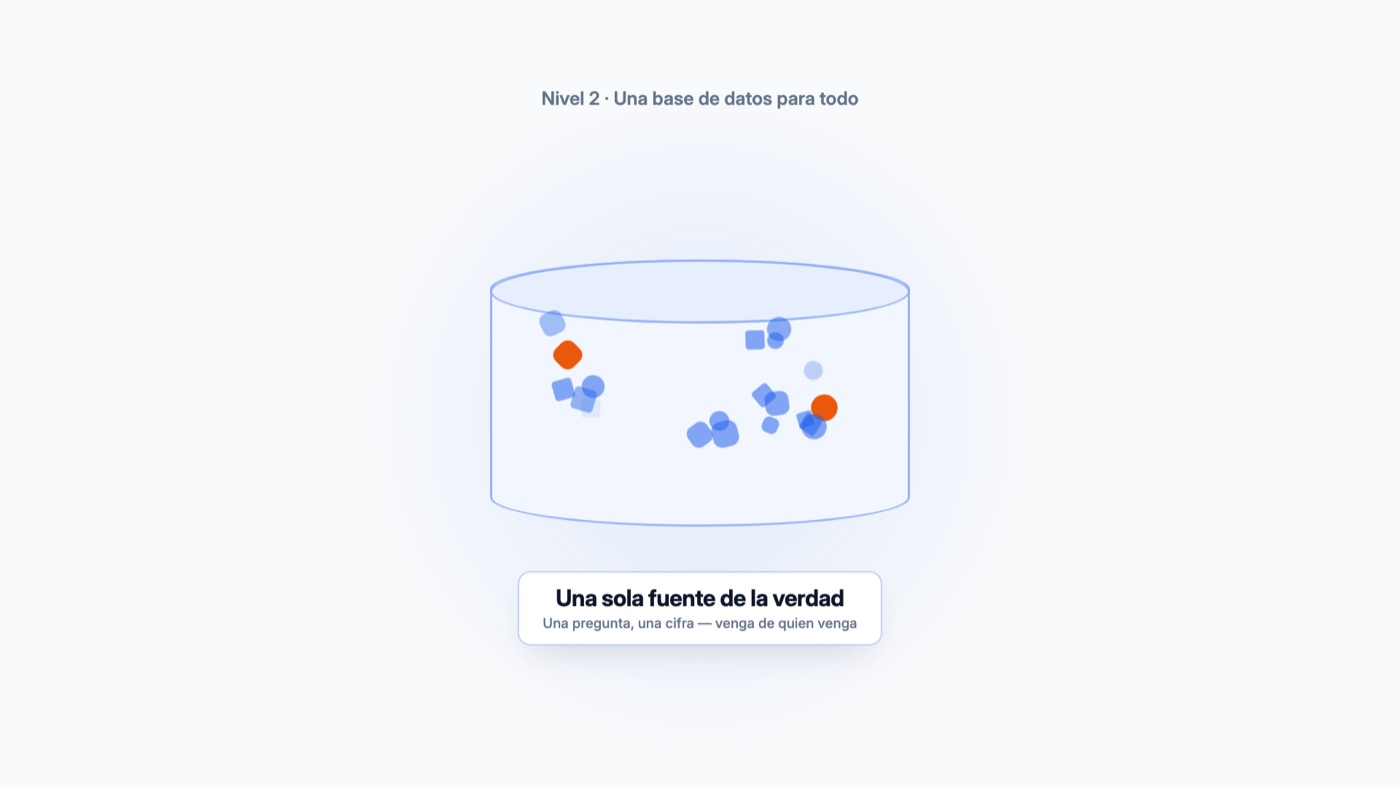
What still breaks is subtler: inside that database, raw data as it arrived sits alongside data that has already been worked on. Both look equally trustworthy. Nobody can tell which is which without asking whoever built it, and we're depending on one person again.
Level 3
Separating the data that arrives from the data you use
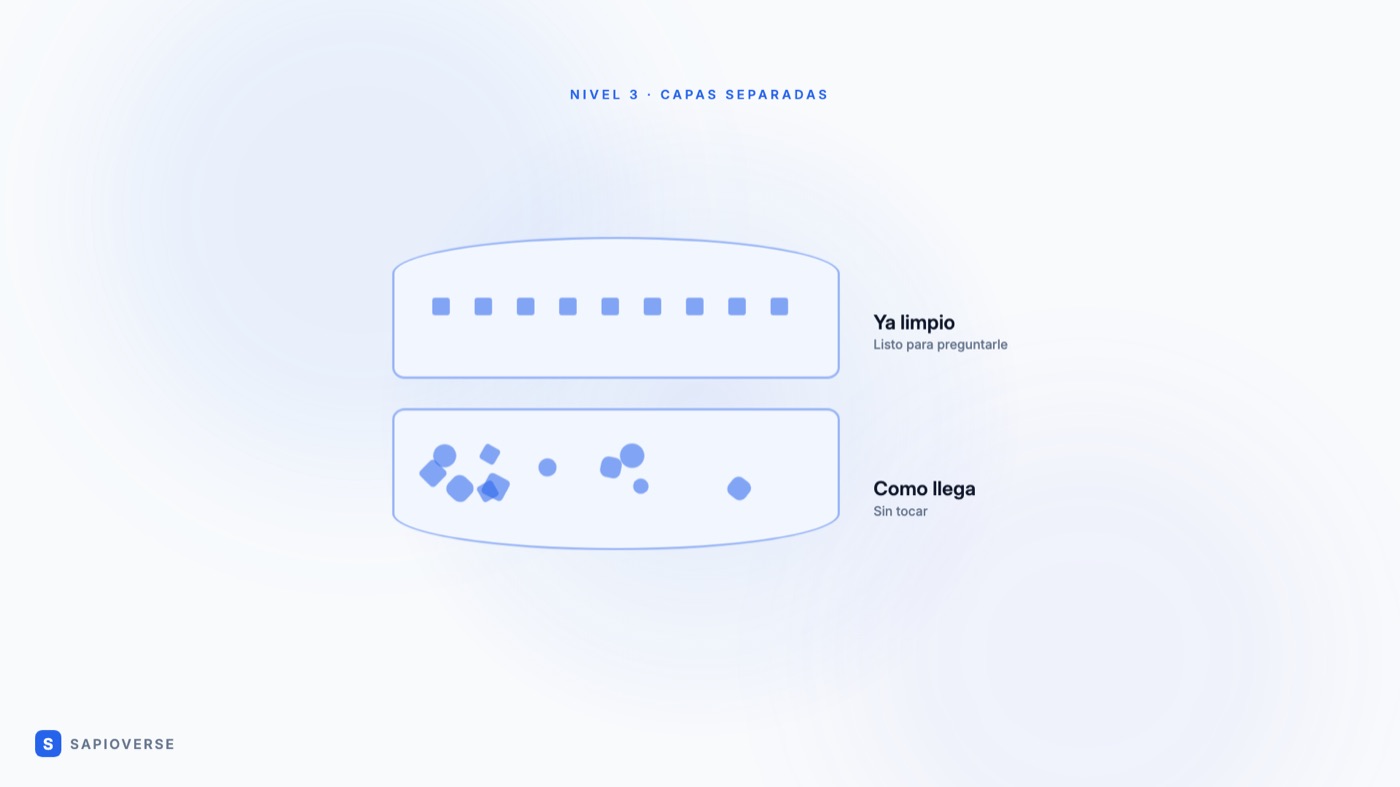
The layers get split. One area for data exactly as it comes in, untouched. Another for data already cleaned, with names unified and duplicates resolved. At last you know which one you can use without asking anybody.
Level 4
The medallion architecture
This is the textbook answer, and it has a name of its own because it has become the standard pattern: the medallion architecture. Three layers, each with a job:
Gold
With your business rules applied
Silver
Clean and standardised
Bronze
Data as it arrived
The gold layer is the one almost nobody explains, and the one that matters most here: it's where your company's rules live. What counts as an active customer. Whether a credit note comes off the month it was issued or the month of the sale. Which product family groups which. None of that is in the ERP: it's in the heads of the people who have been doing the numbers for years.
And this matters for one specific reason
Artificial intelligence and dashboards don't read your company: they read the last layer. They query whatever they find there and answer with whatever is available.
If your business rules aren't in that layer, the answer arrives just as fast, looking just as confident, and wrong. That's worse than no answer at all, because nobody audits it: it came back in two seconds and it looked right.
That's why the question isn't which tool you use. It's which level you're on.
The same thing, in two minutes
This guide is the written version of a video. If you prefer to watch it:
And if you don't know which one you're on?
That's normal, and you don't need to move up a level before getting something out of what you already have. We'll look at it with you and tell you which level you're on, what can be answered today and what would need to change.
And if what you are after is what gets measured in each business model, that list has a guide of its own.